“Bitcoin casino” is a common search, so here is the honest version up front. PlayDash takes crypto through USDT, the Tether stablecoin, on the TRC-20 and ERC-20 networks — not bitcoin sent straight from your wallet. To play “with bitcoin” in practice, you convert BTC or Litecoin into USDT and deposit that, and whether any coin is taken directly is worth checking on the site. This guide covers what sets a bitcoin casino apart, BTC against stablecoins, funding and cashing out in crypto, the popular games like Plinko, Aviator and fishing titles, the limits and the speed, how to spot a safe site, the truth about anonymity and KYC, and legality. The tone is honest and promises nothing — an RTP below 100% is the house edge. The cash balance is held in MYR, and this guide is written for players across Malaysia, Singapore and Thailand.
What Makes a Bitcoin Casino Different
A bitcoin casino takes deposits and payouts in digital currency rather than only in regular money. The pull is speed, low fees and a lighter data trail, and the detail sits below. One thing to keep in mind — “bitcoin casino” describes the payment method, not the games themselves.
Bitcoin, Crypto, and How Casinos Use Them
Bitcoin and other cryptocurrencies are decentralised digital money that lives on a blockchain. There is a split worth knowing — volatile coins like BTC and Litecoin swing in price, while stablecoins like USDT are pinned to the dollar. A casino uses them simply enough. You send crypto to a deposit address, your balance credits, and payouts go back to your wallet. Many sites take stablecoins precisely because the balance does not lurch with the market. The key terms:
- Blockchain — the public ledger behind the coins
- Volatile coin — BTC or LTC, where the price moves
- Stablecoin — USDT, pinned to the dollar
- Wallet — where you hold and send assets
- Network — the chain a coin moves on, such as TRC-20 or ERC-20

The Big Draws: Speed, Low Fees, and Privacy
People pick blockchain for a handful of reasons. Transfers are fast, and payouts on PlayDash run about 10 minutes. Network fees are usually low, and PlayDash adds no operator fee of its own. A payment carries less personal data than a card, and it works where banking methods are limited. The honest flip side matters too — BTC and LTC prices swing, transfers cannot be reversed, and a wrong network or address can cost you the funds.
- Fast payouts, around 10 minutes on PlayDash.
- Low network fees, and no operator fee.
- Less personal data than a card payment.
- But volatile prices on BTC and LTC.
- But irreversible transfers and network-choice risk.
Bitcoin vs Stablecoins at PlayDash
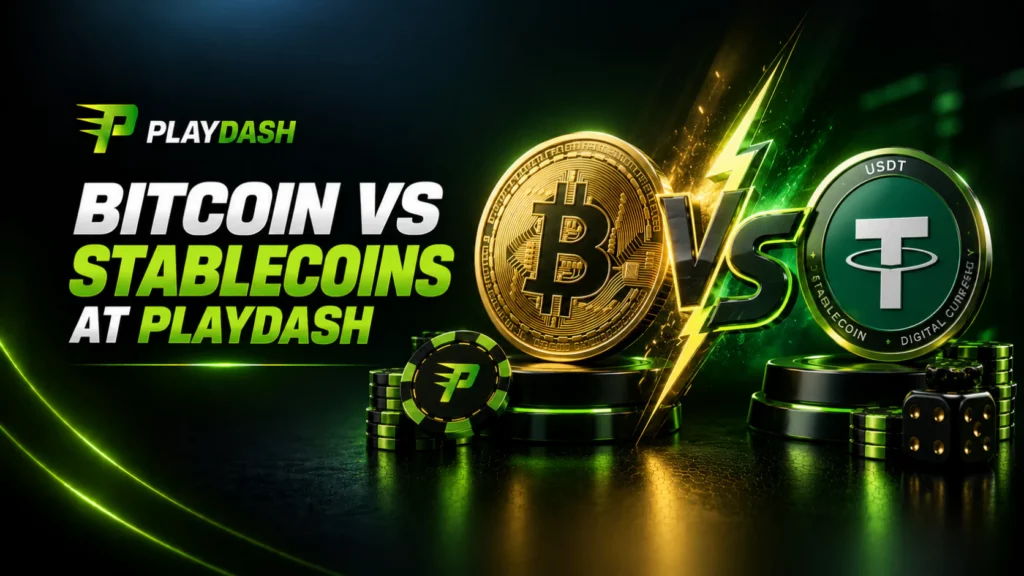
Here is the part that separates this from a general crypto page. On PlayDash, crypto means USDT on TRC-20 or ERC-20, not bitcoin direct. Below is why that is, and how you still play “with bitcoin”.
Why PlayDash Settles Everything in USDT
PlayDash takes and pays crypto in USDT, the Tether stablecoin, on the TRC-20 network (TRON) and the ERC-20 network (Ethereum). The reason is stability — USDT tracks the dollar, so a balance and a win do not rise and fall with the price of bitcoin, and the sums stay predictable. TRC-20 is usually cheaper and faster on network fees, while ERC-20 runs on Ethereum. A crypto withdrawal is open only to players who deposited in crypto.
| Network | Coin | Notes |
|---|---|---|
| TRC-20 (TRON) | USDT | Usually cheaper and faster fees |
| ERC-20 (Ethereum) | USDT | Runs on Ethereum |
Turning BTC or Litecoin into a Deposit
If you hold BTC or Litecoin and PlayDash takes USDT, the usual route is to swap the coin for USDT and send that. Direct BTC or LTC acceptance is not confirmed in the material here, so check it on the site rather than assume it.
Hold
BTC or Litecoin in your wallet or on an exchange
Swap
it for USDT on the TRC-20 or ERC-20 network
Copy
the USDT deposit address and network from the PlayDash cashier
Send
the USDT, matching the coin and the network exactly
Funding Your Account with Crypto
Here is the full path of the money — wallet, USDT deposit, and the payout of a win. The three parts sit below. The minimum deposit is the equivalent of MYR 30, and the minimum withdrawal is MYR 50.
Setting Up a Wallet and Buying Coins
First the wallet. You can use a custodial wallet on an exchange, where the platform holds the keys, or a non-custodial one, where you hold them yourself. Have USDT ready, or BTC and LTC to convert, and pick the network. Guard the basics — the seed phrase, two-factor login, and a check of the address and network before sending.
- A wallet, custodial or non-custodial.
- USDT, or coins to convert into it.
- The right network chosen, TRC-20 or ERC-20.
- Seed phrase stored safely, two-factor login on.
Sending a Bitcoin Deposit to PlayDash
To deposit, open the cashier, choose the crypto option, and take the USDT address and the network it asks for. Send exactly that coin on exactly that network from your wallet, then wait for network confirmations, since crediting is usually quick. This part is critical — a wrong network can lose the funds. The minimum is the equivalent of MYR 30.
- Open the cashier and choose deposit.
- Copy the USDT address and the required network.
- Send the matching coin and network from your wallet.
- Wait for confirmations, and the balance credits.

Requesting a Bitcoin Payout

A crypto payout is available if your deposit was in crypto. Give a USDT address on the same network and request the withdrawal. The facts are plain — the minimum is MYR 50, there is no operator fee, and payouts run about 10 minutes. Limits run to 5 requests or MYR 50,000 a day, whichever comes first, resetting at 8:00 AM UTC+8. A large withdrawal, or lifetime deposits above EUR 10,000, can trigger KYC.
- A crypto payout only if you deposited in crypto.
- Minimum MYR 50, with no operator fee.
- Around 10 minutes, up to 5 requests or MYR 50,000 a day.
- KYC possible on large sums.
Popular Bitcoin Casino Games at PlayDash
With a crypto balance, the provably-fair instant games draw the most play. Below are the ones that have their own full guides.
Playdash Plinko
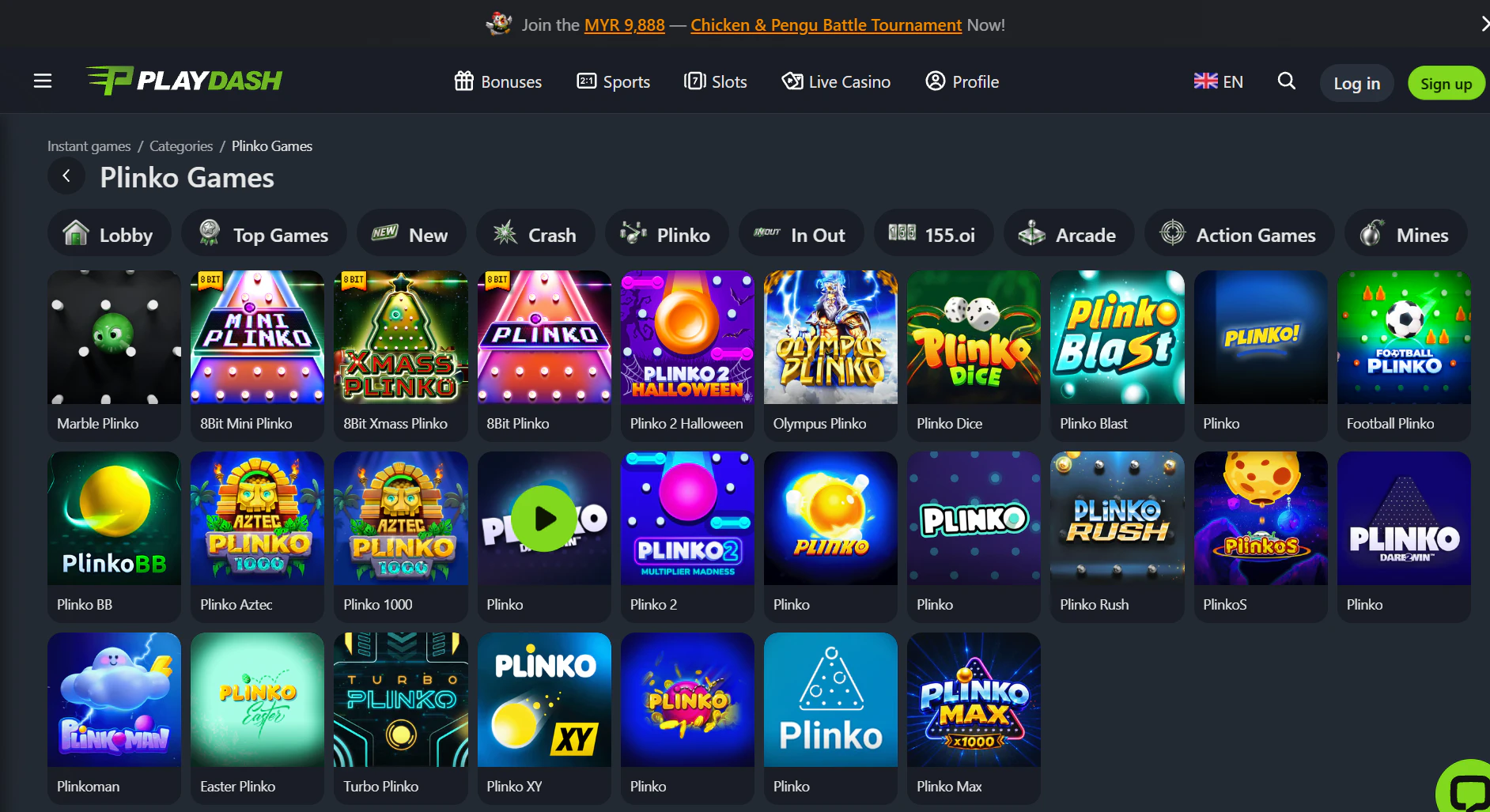
Plinko is an instant “falling ball” game — a ball drops through a grid of pegs into a slot with a multiplier, and a riskier setup with more rows and a higher risk level raises both the potential multiplier and the swing. On PlayDash it plays on a real balance, USDT included, with stakes from small amounts and rounds that last seconds, which suits a quick crypto session. The exact provider and version are worth checking on the site. The full Plinko guide has the detail.
Playdash Aviator
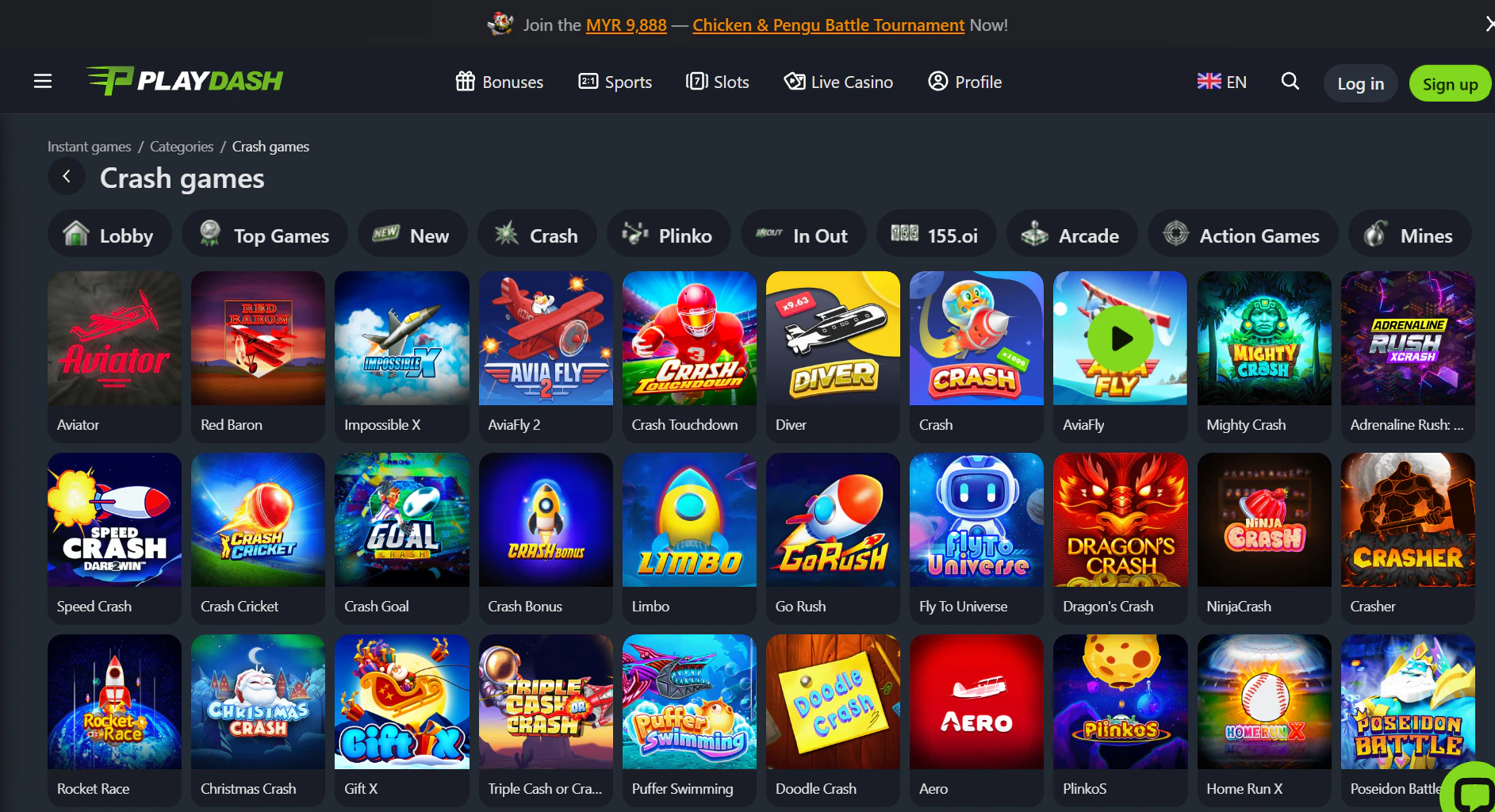
Aviator is a crash game — a multiplier climbs as a plane flies, and the job is to cash out before it flies away, with auto-cashout and two bets per round supported. On PlayDash it plays on a real balance, USDT included, with fast rounds and a timing decision at the centre. On the site the crash game may be Aviator or the similar Aviatrix, so confirm the exact name and provider. The full Aviator guide covers it.
Fishing Games
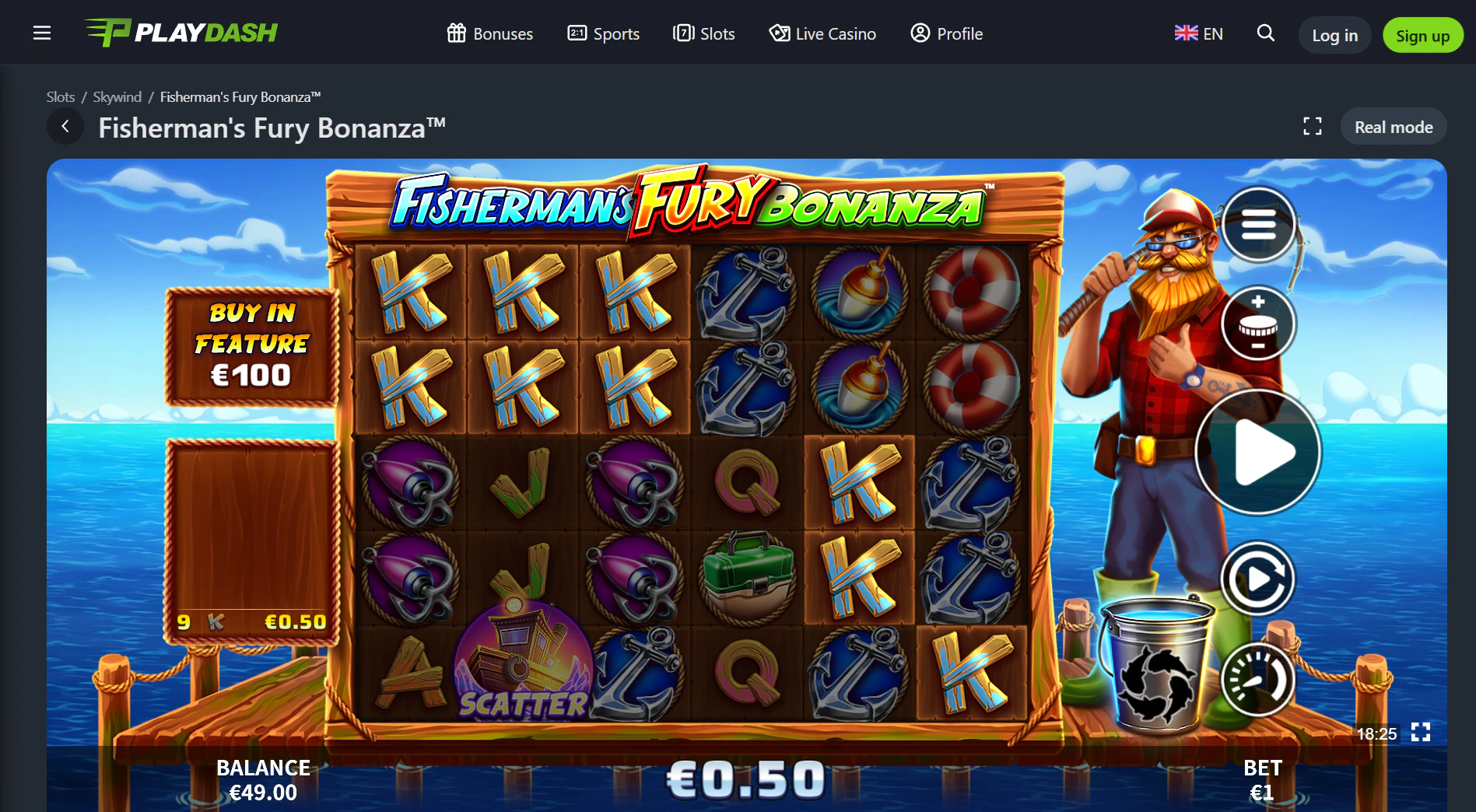
Fishing games are arcade shooters — you fire at fish for multipliers on your stake, a genre popular across Asian gaming.
PlayDash carries a set of them, among others:
- Trout’s Treasure – Fishing Season
- Go High Gone Fishing
- Fishing Club and Winter Fishing Club
- Animal Fishing
- Bombing Fishing
They play on a real balance, USDT included, and the full fishing guide lists them with providers.
How Fast, How Cheap, and How Much
Pulling the numbers together — the minimum deposit is MYR 30, the minimum withdrawal MYR 50, there is no operator fee, and payouts run about 10 minutes. The withdrawal limit is 5 requests or MYR 50,000 a day, resetting at 8:00 AM UTC+8, and the maximum payout is MYR 500,000 per bet. A network fee still applies, and TRC-20 is usually cheaper than ERC-20.
| Item | Crypto (USDT) | Fiat (MYR) |
|---|---|---|
| Speed of payout | ~10 minutes | Varies by method |
| Operator fee | None | None |
| Network fee | Yes, TRC-20 cheaper | Not applicable |
| Min deposit / withdrawal | ~MYR 30 / MYR 50 | MYR 30 / MYR 50 |
How to Spot a Safe Bitcoin Casino
When you weigh any bitcoin casino, a few things matter — a licence, provably-fair games, clear withdrawal and KYC terms, a reputation with 24/7 support, and SSL encryption. For PlayDash, that means an Anjouan licence, 256-bit SSL, and a 24/7 live chat. The checks sit below.
- A named licence
- Provably-fair games
- Clear withdrawal and KYC terms
- 24/7 support and SSL encryption
Licence, Testing, and Reputation Checks
On the licence, PlayDash holds one from Anjouan, an offshore regulator, which is a lighter authority than the strictest ones. On fairness, provably-fair games from providers like Spribe can be checked independently. Beyond that, look at reviews, payout speed and the quality of support. One caveat stands — an offshore licence is neither a guarantee nor a local permission.

a licence, provably-fair games, fast documented payouts
responsive 24/7 support

no licence, vague withdrawal terms, no fairness proof
pressure to deposit, or hidden limits
Bitcoin Casino Anonymity and KYC Reality
The “crypto equals full anonymity” idea does not hold. You can play without verification, but KYC is triggered by a withdrawal, by lifetime deposits above EUR 10,000, or by suspicious activity, and then documents are asked for. Blockchain transfers are public and traceable too. So digital assets gives more payment privacy than a card, but not total anonymity at cash-out.
- Private — less personal data at the payment step than a card
- Not private — the blockchain record of a transfer is public
- Not anonymous — KYC applies at withdrawal or on a flag
Is Bitcoin Gambling Legal?
Whether online gambling and crypto play are lawful depends on the player’s jurisdiction, allowed in some places and restricted in others, and checking that is the player’s own responsibility. The Anjouan licence lets the operator run its business, but it does not make play lawful where it is restricted. Nothing here is legal advice.
- Whether online gambling is lawful where you live
- Whether digital payments face any local limit
- That an offshore licence is not a local permit
FAQ PlayDash Bitcoin Casino
Digital payments on PlayDash run through USDT, the Tether stablecoin, on the TRC-20 and ERC-20 networks, and direct BTC acceptance is not confirmed in the material here, so check it on the site. The practical way to "play with bitcoin" is to swap BTC for USDT and deposit that, which gives a balance that stays stable against price swings. A crypto payout is available if your deposit was in crypto.
As with bitcoin, the main crypto on PlayDash is USDT on TRC-20 or ERC-20, and direct Litecoin acceptance is not confirmed, so check on the site. If you hold LTC, swap it for USDT on the network you want and deposit that. That removes the effect of the Litecoin price on your balance and keeps the sums simple to follow.
Crypto withdrawals on PlayDash are usually fast, about 10 minutes after approval, with no operator fee, though the blockchain charges its own network fee. The minimum is the equivalent of MYR 50, and the limit is 5 requests or MYR 50,000 a day, resetting at 8:00 AM UTC+8. Large sums can need KYC, which adds time. A crypto payout applies if you deposited in crypto.
Not fully. You can play without verification, but KYC is triggered at withdrawal, by lifetime deposits above EUR 10,000, or by suspicious activity, and then documents are requested. Blockchain transactions are public too. Crypto gives more payment privacy than a card, but it is not total anonymity, and the chain record of a transfer stays visible.
The minimum deposit is the equivalent of MYR 30 in USDT, and the minimum withdrawal is MYR 50. There is no operator fee on deposits or withdrawals, but the network fee depends on the blockchain, with TRC-20 usually cheaper than ERC-20. Before sending, make sure the coin and network match the ones shown in the cashier, or the funds can be lost.